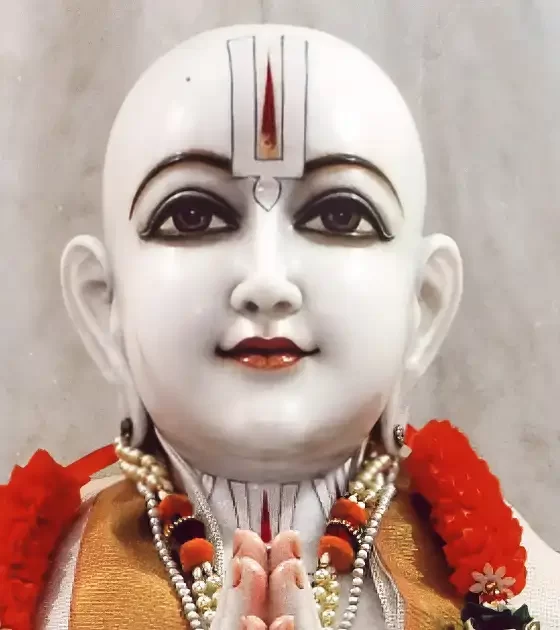
Thiru Narayana and Ramapriya – The famous Deities of Melukote
Source: Shri Sudarshan Sandesh, Nov06-Jan07, pages 35 to 37 (as Published)
Estimated reading time: 8 minute(s)
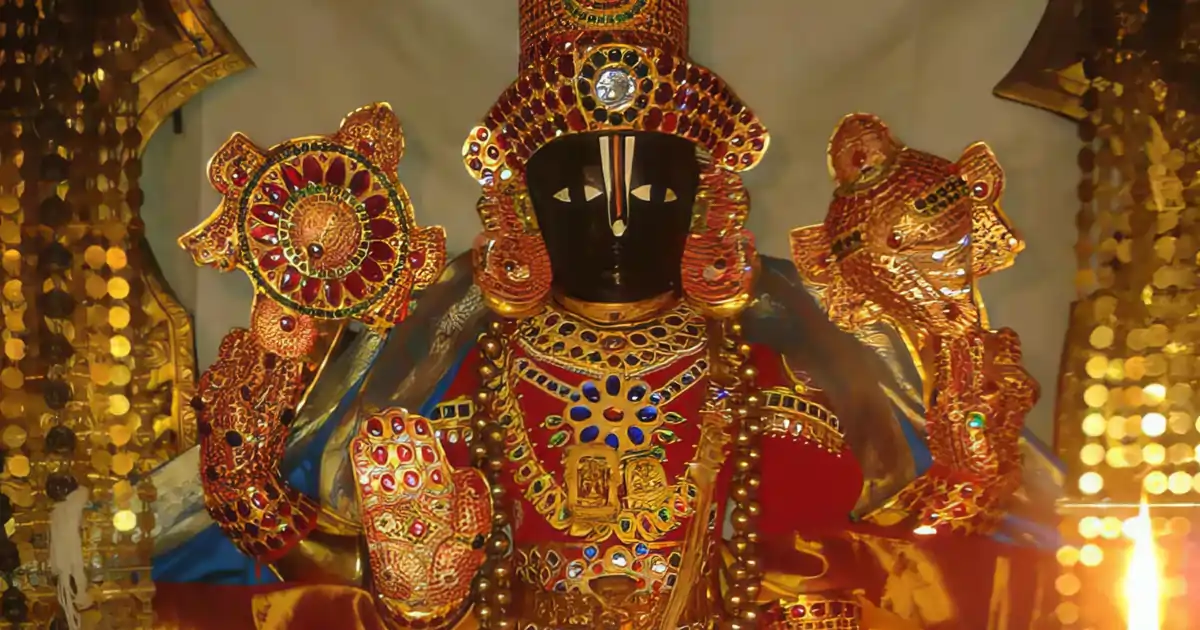
During the beginning of Satyayuga, Lord Brahma requested Lord Narayana to bestow upon him a murti for worship. Lord Narayana fulfilled the request by creating an image of Himself for Lord Brahma. The murti was 6 feet tall, made of shiny black stone, with four arms and hands holding a chakra, conch, club, and one palm outward bestowing benedictions. He was bedecked with golden ornaments, precious jewels, and diamonds. Lord Brahma was pleased and began worshipping the Lord, who eventually became known as Thiru Narayana.
Lord Brahma then gave Thiru Narayana to one of his sons, Sanat Kumar, who traveled to South India to perform tapasya and establish permanent worship for Thiru Narayana.
Because Lord Brahma gave Thiru Narayana to Sanat Kumar, Lord Brahma was without a personal murti. He prayed to Lord Narayana requesting another Deity to worship, and the Lord re-manifested Himself as a smaller metal murti, along with Sri-Devi and Bhu-Devi. Lord Brahma was pleased and worshipped the new deity for the remaining part of Satyayuga and throughout most of Tretayuga, right up to the time of Lord Ramachandra’s return to Ayodhya.
When Lord Rama gave His Deity, Sri Ranganatha, away, He became perturbed at not having a personal Deity to worship. Lord Brahma saw His predicament, and out of his compassion gave the Deities of Lord Narayana, Sri-Devi, and Bhu-Devi, to Lord Rama, who worshipped Them with care and devotion. It was then that the Deity became known as Ramapriya – from Lord Rama’s heart.
After Lord Rama departed from this planet, Ramapriya was worshipped by Kusha, Rama’s son. When Kusha’s daughter, Kanakakamalini, married a king of the Yadu Dynasty, Kusha offered his daughter a gift of wealth. However, she wasn’t happy until she received the murti, Ramapriya, to worship herself. Ramapriya remained in the Yadu Dynasty until the time of Krishna and Balarama in Dwaraka.
When Lord Balarama was performing his tirtha-yatra, he visited Thiru Narayana and was surprised to see the similarity between Thiru Narayana and Ramapriya, who was in Dwaraka. After completing his tour, he returned to Dwaraka and informed Krishna that Thiru Narayana did not have an utsava-murti (processional deity). So They returned to Thiru Narayana with Ramapriya and installed Him as the utsava-murti of Thiru Narayana.
Even during the beginning of Kali Yuga, Thiru Narayana and Ramapriya were worshipped without interruption until the Muslim invasion, which looted the abode of the Lord. The utsava-murti (Ramapriya) was stolen and taken to the north.
Thiru Narayana was hidden by the local devotees who then departed and let the forest take control of the temple.
While on a preaching tour from Sri Rangam, Ramanujacharya arrived at Melukote. One morning, while taking a stroll in a Tulsi garden, he came across an image buried underneath an anthill. He dissolved the anthill with milk and holy water, and to his delight, Lord Thiru Narayana stood before him, waiting to be reinstalled and worshipped. The night before, Thiru Narayana appeared in a dream to Ramanuja requesting service, where all the local devotees should reconstruct a temple so regular worship could be conducted. All of Ramanuja’s disciples and the local inhabitants quickly built a temporary thatched structure, installed the Deity, and engaged themselves in the Lord’s service. Within a short period of time, a beautiful temple was built.
After making so many nice arrangements for Thiru Narayana, Ramanuja decided to observe the Brahmotsava festival, but there wasn’t any utsava murti to complete the occasion. Again, Thiru Narayana appeared to Sri Ramanuja in a dream saying, “My dear Ramanuja, I am very pleased with your service, but since I do not have an utsava-vigraha here, I cannot go out of the temple to bless my devotees and free the fallen conditioned souls from sin. Therefore, quickly return Ramapriya to me, Who is now with the Emperor of Delhi.”
After receiving the instructions from Thiru Narayana, Ramanuja and a few of his disciples set out for Delhi. It took several months to reach their destination. Upon arriving, Ramanuja was received with reverence by the Emperor of Delhi, who was astonished to see the luster of Ramanuja’s body, his scholarship, and great personality. After inquiring about Ramanuja’s purpose, the Emperor granted his request for the murti of Ramapriya.
Ramanuja was taken inside a large room which stored hundreds of murtis that had been taken from temples throughout. The Emperor requested him to choose the Deity and take it, but to everyone’s surprise, Ramapriya was not to be found. Then the Emperor remembered that one Deity was with his daughter, Bibi Lachimar, who had great affection for Ramapriya, keeping Him inside her harem. Upon entering the harem, Ramanuja instantly recognized Ramapriya.
Now the Emperor was in a dilemma because he did not want to incur the displeasure of his daughter nor that of Ramanuja. To settle the matter, the Emperor requested Ramanuja to call his Lord.
Ramapriya, in the form of a child, jumped down from the couch on which the princess had placed him and walked towards Ramanuja, who embraced Him with all the fondness of a parent finding his long-lost son. Ramanuja then gave Ramapriya the name Sampat Kumara, or Selva Pillai, which means beautiful, darling child. The Emperor was amazed at the spiritual potency of Ramanuja and allowed him to take Ramapriya back to Melukote.
After a few days of separation from Ramapriya, Bibi Lachimar became overwhelmed with sorrow and grew sick. Finally, her father ordered a regiment of soldiers to retrieve the Deity from Ramanuja. Bibi Lachimar also went, and Kubera, a young prince in love with her, followed her and the regiment.
Ramanuja and his disciples walked day and night without rest, knowing they were being followed by the Emperor’s regiment, until crossing the boundary of the Emperor’s territories, they arrived in Melukote. Ramanuja then installed the utsava-vigraha of Thiru Narayana, Ramapriya, in a secret place within the temple.
While the regiment stopped at the boundary lines, Bibi Lachimar proceeded south alone without food or rest, since the pangs of separation tormented her. Still, Kubera followed her, trying to console and give hope to the distressed princess. Eventually, the couple arrived in Melukote. Bibi Lachimar’s desires were finally fulfilled when she entered the temple, never to return.
Kubera used to serve Bibi Lachimar like his own Deity, so when she left, he was unable to remain in Melukote. He gave up his Muslim habits and went to Sri Rangam, taking refuge at the lotus feet of Sri Ranganatha. One day, while absorbed in meditation, he heard a divine voice saying, “O best amongst the Yavanas, I am here to grant liberation to the Vaisnavas who take refuge in Me, and Lord Jagannatha is there to grant liberation unto the fallen ones.” Kubera left the next morning for Jagannath Puri. After months of traveling, he arrived in Jagannath Puri, where he was blessed with the darshan of Sri Jagannatha, the Lord of the Universe and redeemer of all fallen souls.
Even today, the Lord is still bestowing mercy on anyone who is willing to make the effort to visit Melukote. A part of the statement by the Lord that says “Kali is forbidden entry” still stands here today. There is no meat-eating, no drinking, and very little smoking within the township. Everyone is polite, sweet, hospitable, and relaxed, especially welcoming visitors. The local brahmanas are anxious and happy to explain the pastimes of Thiru Narayana, Ramapriya, and Sri Ramanuja, who lived here for fourteen years. Darshan is always pleasing and lasting, reflecting a high standard of worship, maintenance, and devotion. The history is rich and colorful, full of spiritual episodes that leave one inspired, wishing to stay longer or to return as soon as possible.
By Jaya Vijaya Dasa
Summary:
The passage, written by Jaya Vijaya Dasa, narrates the divine history of the murti (idol) of Thiru Narayana and its journey through various hands, emphasizing its significance and the miracles associated with it. It highlights the devotion and efforts of saints like Ramanujacharya in preserving and worshiping the deity.
Important Points:
- Creation and Worship of Thiru Narayana:
- During Satyayuga, Lord Brahma requested Lord Narayana for a murti for worship.
- Lord Narayana created a 6-feet tall black stone image with four arms, adorned with golden ornaments and precious jewels.
- Lord Brahma worshipped this murti, later known as Thiru Narayana, and then gave it to his son, Sanat Kumar.
- Transmission and Worship of Ramapriya:
- Lord Brahma requested another deity from Lord Narayana and received a smaller metal murti with Sri-Devi and Bhu-Devi.
- Lord Rama, needing a deity to worship, received these deities from Lord Brahma and named the deity Ramapriya.
- Ramapriya was worshipped by Kusha, Rama’s son, and eventually by Krishna and Balarama in Dwaraka.
- Historical Miracles and Devotion:
- Balarama recognized the similarity between Thiru Narayana and Ramapriya and installed Ramapriya as the utsava-murti (processional deity) of Thiru Narayana.
- During the Muslim invasion, the utsava-murti was stolen, and Thiru Narayana was hidden and neglected.
- Ramanujacharya’s Efforts:
- Ramanujacharya discovered Thiru Narayana buried under an anthill and reinstalled and worshipped Him.
- Following a dream, Ramanuja retrieved Ramapriya from the Emperor of Delhi, who was impressed by Ramanuja’s spiritual potency.
- Ramapriya, now named Sampat Kumara (Selva Pillai), was returned to Melukote, and the temple was revitalized.
- Devotion and Legacy:
- Bibi Lachimar, the Emperor’s daughter, followed Ramapriya to Melukote and stayed there, while Kubera, who loved her, eventually took refuge in Sri Ranganatha and later Jagannath Puri.
- Melukote remains a place of high devotion, maintaining strict religious practices and welcoming visitors warmly.
- The passage highlights the ongoing divine presence and mercy of Thiru Narayana, Ramapriya, and Sri Ramanuja.
- Cultural and Spiritual Significance:
- The history of Thiru Narayana and Ramapriya is rich with spiritual episodes that inspire devotion and reverence.
- The community in Melukote upholds a high standard of worship and devotion, reflecting the lasting impact of these divine events and figures.
This summary encapsulates the divine journey of Thiru Narayana and Ramapriya, the miracles associated with them, and the enduring devotion in Melukote, largely attributed to the efforts and spiritual potency of Ramanujacharya.