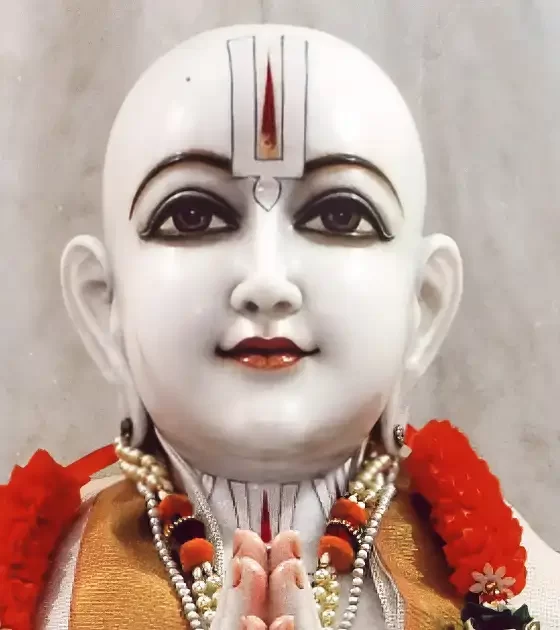
The Divine Devi Andal’s Poetry: One of Our Great Alvars
Source: Shri Sudarshan Sandesh, Feb07-Apr07, page 37 (as Published)
Estimated reading time: 5 minute(s)
Andal composed two significant works in her short life. Both are in Tamil and are unique in their literary, philosophical, religious, and artistic content. Her contribution is even more remarkable considering that she was a teenage girl when she composed these poems, at a time when there is no other record of Tamil women composing poetry. Far from being the prattlings of a youngster, Andal’s verses display a literary and religious maturity far beyond her years.
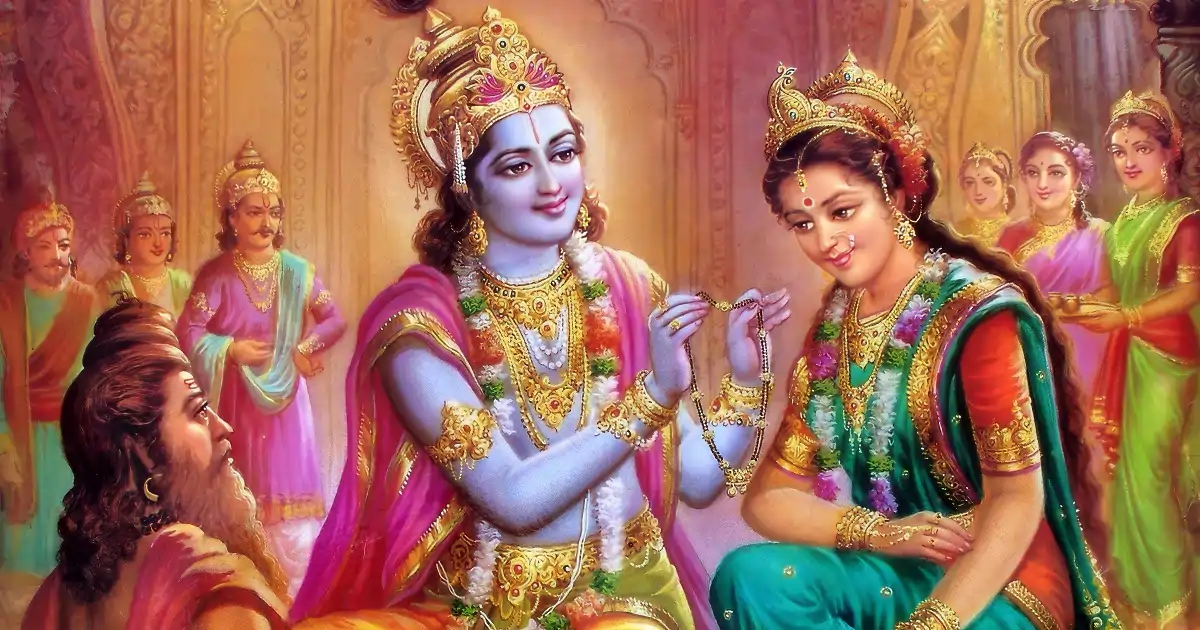
Her first work is the Tiruppavai, a poem of thirty verses in which Andal imagines herself to be a cowherd girl during the incarnation of Lord Krishna. She yearns to serve Him and achieve happiness not just in this birth but for all eternity, and describes the religious vow (paavai) that she and her fellow cowgirls will take for this purpose.
The second is the Nacciyar Tirumoli, a poem of 143 verses. Tirumoli, literally meaning “sacred sayings,” is a Tamil poetic style in which the work is composed. Nacciyar means goddess, so the title means “sacred sayings of our Goddess.” This poem fully reveals Andal’s intense longing for Vishnu, the Divine Beloved. Utilizing classical Tamil poetic conventions and imitating stories from the Sanskrit Vedas and Puranas, Andal creates imagery that is quite possibly unique in the entire history of Indian religious literature.
The impact of these works on the daily religious life of South Indians has been tremendous. Just like the Ramayana, people are never tired of listening to the Tiruppavai. The poem itself is recited with great religious fervor by women, men, and children of all ages, particularly in Tamil Nadu. The daily services in most Vaishnava temples and households include its recitation.
Both of these works, particularly the Tiruppavai, have been commented on extensively by innumerable scholars in a number of languages over the centuries. Today, we are fortunate to have many translations of the Tiruppavai in Western languages, which make these poems available to an even wider audience.
Kulasekara Alvar’s Devotion to Lord Rama and Lord Krishna
Kulasekara Alvar was a King of the Chera country of Tamil Nadu (present-day Kerala). He is credited with one poem called Perumaal Thirumozhi (Lord’s Sacred Poem), containing 105 verses in Tamil, many of which are dedicated to Lord Rama and Lord Krishna.
Kulasekara Alvar was a legendary Rama bhakta. He devoted almost a third of his verses to Lord Rama. While other Alvars celebrated Rama’s victory over the evil Ravana, Kulasekara Alvar chose to sing a lullaby to Rama, with “Raaghavene thaalELO.” In another part of his poem, he pours out his heart and wails “emm iraamaa!O,” expressing Dasaratha’s sorrow upon Rama’s departure. Alvar’s Rama bhakti was so intense that one day, during a discourse of Srimad Ramayana, he became distraught and ordered his generals to get his armed forces ready so that he could rush to the aid of Lord Rama!
For Sri Vaishnavas, there is no greater expression of devotion for our Lord Sriman Narayana than devotion for our Lord’s devotees. Sri Vaishnavas consider reverence towards our Lord’s devotees as the culmination of our reverence to Lord Sriman Narayana. No other Alvar expressed this principle as eloquently as Kulasekara Alvar. This is completely in character, for he is said to have unhesitatingly put his hand inside a pot with a cobra to prove the innocence of our Lord’s devotees maliciously accused of stealing the royal jewels.
Unlike Thondaradippodi and to some extent Nammazhvar, whose relevant verses tend to be guidance for our behavior towards fellow devotees, Kulasekara Alvar expressed these sentiments in the first person. There are several verses where he starts out with beautiful descriptions of our Lord, and then, when we expect him to finally be surrendering to such a Lord, he ends with a surrender to the devotees of such a Lord!
Summary:
The article highlights the significant contributions of two revered Alvars, Andal and Kulasekara Alvar, to Tamil religious literature and devotion. Andal, a teenage girl, composed two profound works: the “Tiruppavai” and “Nacciyar Tirumoli.” The “Tiruppavai,” with its 30 verses, portrays her as a cowherd girl longing to serve Lord Krishna and achieve eternal happiness. The “Nacciyar Tirumoli,” a longer poem of 143 verses, expresses her intense devotion to Vishnu using classical Tamil poetic conventions. Andal’s works have had a lasting impact on South Indian religious life, with the “Tiruppavai” being widely recited and extensively commented on over the centuries.
Kulasekara Alvar, a king from the Chera country, is renowned for his deep devotion to Lord Rama and Lord Krishna, as expressed in his poem “Perumaal Thirumozhi.” He dedicated a significant portion of his verses to Rama, with some depicting Rama’s lullabies and Dasaratha’s sorrow. His intense devotion was so profound that he once prepared to send his army to aid Rama. Kulasekara Alvar also exemplified the principle of reverence towards the Lord’s devotees, often expressing this devotion in the first person in his poetry. His unique approach underscored the Sri Vaishnava tradition of honoring the Lord’s devotees as a culmination of devotion to the Lord himself.
Important Points:
Andal’s Contributions:
- Composed the “Tiruppavai” (30 verses) and “Nacciyar Tirumoli” (143 verses) as a teenager.
- “Tiruppavai” depicts her longing to serve Krishna, while “Nacciyar Tirumoli” expresses intense devotion to Vishnu.
- Andal’s works are unique in their literary, philosophical, and artistic content.
- Her poems have had a significant impact on South Indian religious life, particularly in Tamil Nadu.
- The “Tiruppavai” is widely recited and commented on by scholars in multiple languages.
Kulasekara Alvar’s Devotion:
- King of the Chera country (present-day Kerala).
- Composed “Perumaal Thirumozhi,” a poem of 105 verses, with a strong focus on Rama and Krishna.
- Demonstrated intense Rama bhakti, even preparing to send his army to aid Rama.
- Emphasized reverence towards the Lord’s devotees as a culmination of devotion to the Lord.
- Expressed devotion in the first person, highlighting personal surrender to the devotees of the Lord.
Cultural and Religious Impact:
- Andal’s and Kulasekara Alvar’s works are integral to Sri Vaishnava traditions.
- Their poems are recited in daily services in Vaishnava temples and households.
- Both Alvars’ contributions continue to inspire devotion and are studied and celebrated by scholars and devotees alike.