The Brief Story & Introduction of The Holy Puranas
Source: Shri Sudarshan Sandesh, Feb07-Apr07, pages 17-19 (as Published)
Estimated reading time: 9 minute(s)
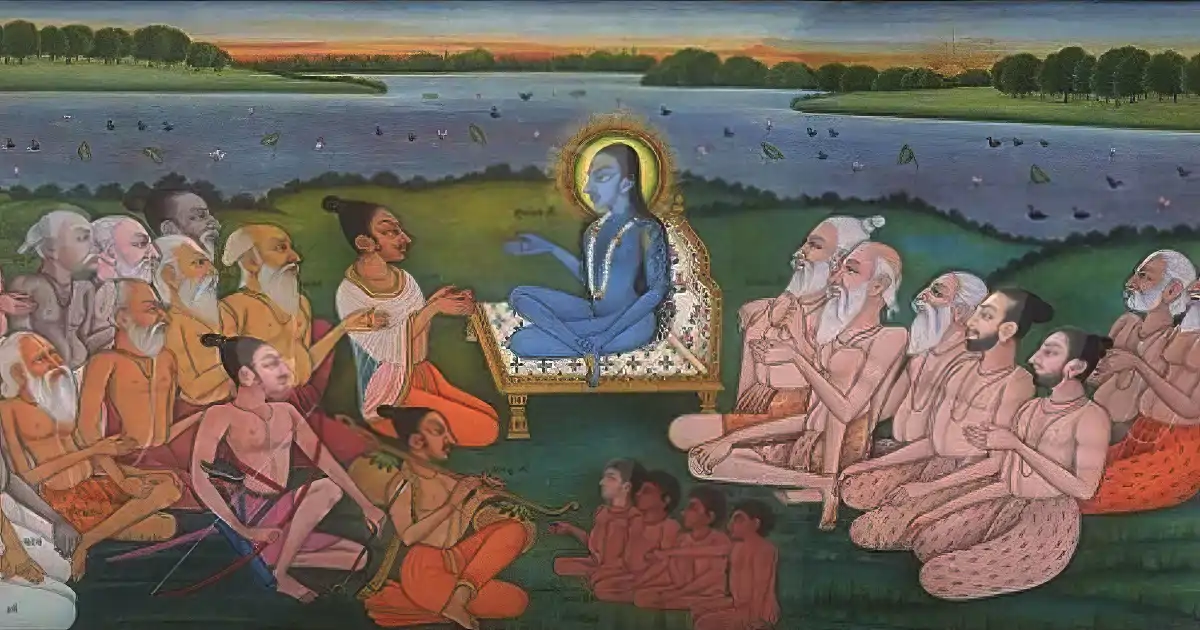
Vishnu Purana The Vishnu Purana is considered the most important of all the Puranas. It contains the five technical divisions of the Puranas and is divided into six adisas. It deals with the events of Varahakalpa and contains twenty-three thousand shlokas. The theme revolves around the ten incarnations of MahaVishnu, making it one of the most ancient Puranas and earning it the name Puranaratna (gem of Puranas). The method of narration is in the form of Sage Parasara teaching his disciple Maitreya. Since there is a reference in it to the Maurya dynasty, it is surmised that this was composed in the first or second century A.D. The narrator himself states: “Vyasa, adept in the composition of Puranas, composed this Puranasamhita with Akhyanas, Upakhyanas, Githas, and Kalpanirayas. A Suta named Romaharsana was Vyasa’s chief disciple. The broad-minded Vyasa gave that samhita to that Suta. Romaharsana had six disciples named Sumati, Agnivarchas, Mitrayus, Sarhsapayana, Arkatrvana, and Savarni. Of these, Arkatrvana, Savarni, and Sarhsapayana, born in the Kasyapagotra, have composed Puranasamhitas. There is yet another samhita composed by Romaharsana which was the basis of the samhitas of his three disciples. I have composed Vishnu Purana based on the above four samhitas.” If a man gives the Vishnu Purana as a gift on the full moon day in the month of Asadha (July) with Jaladheenu, he will attain Vishnupada.
Naradiya Purana This Purana is in the form of a narration by Narada to Sanatkumara. In this book of twenty-five thousand verses, Narada teaches the dharmas of Bhratkalpa. If this is given as a gift on the full moon day in the month of Asvina, there will be great prosperity.
Padma Purana This Purana is divided into six Khandas comprising fifty-five thousand verses. The six Khandas are Srstikhanda, Bhumikhanda, Svargakhanda, Patalakhanda, Uttarakhanda, and Kriyayogasara. The Uttarakhanda describes the importance of all months and also the lotus, the seat of Brahma. This contains the stories of Sakuntala and Sri Rama as described by Kalidasa in his works Sakuntala and Raghuvamsa, which has made some believe that this Purana was written after Kalidasa. If this Purana is given as a gift with a cow in the month of Jyestha (June), it brings prosperity.
Garuda Purana This Purana is in the form of instructions to Garuda by Vishnu. It deals with astronomy, medicine, grammar, and the structure and qualities of diamonds. This Purana is dear to Vaishnavites. The latter half of this Purana deals with life after death. The Hindus of north India generally read this Purana while cremating the bodies of the dead. It has given great importance to the origin of Garuda. There are eight thousand verses in this Purana. This Purana should be given as a gift along with an image in gold of a swan to gain prosperity.
Varaha Purana The mode of narration in this Purana is Varaha, the third incarnation of Vishnu, narrating the story. The theme focuses on holy places and mantras. It states that the goddess of earth prayed to MahaVishnu, and that prayer took the form of a goddess. This Purana contains fourteen thousand verses. If one gives it as a gift along with a golden image of Garuda on the full moon day in the month of Caitra (April), one will attain Vishnuloka.
Bhagavata Purana This is the most popular and widely circulated of all the Puranas and is dear to Vishnu devotees. Divided into twelve Skandhas, it contains eighteen thousand shlokas. All the incarnations of Vishnu are described in this Purana. The most interesting Skandha is the tenth, in which the life and activities of Sri Krishna are described. There was once a belief that it was Baladeva, who lived in the thirteenth century A.D., who composed this Purana. But this belief was dismissed when it was found that Vallabacarya of Bengal, who lived in the eleventh century A.D., had made references to this Purana in some of his works. Bhagavata accepts Kapila and Buddha as incarnations of Vishnu. The Bhagavatam has been translated into all Indian languages. This Purana has to be given as a gift on the full moon day in the month of Proshthapada (September).
Brahmanda Purana This Purana deals with the origin of the universe as told by Brahma. In the beginning, there was a golden egg, and the prapancha (universe with its activities) was formed out of it. Portions of Adhyatma Ramayana, references to Bharda and Krishna, and the incarnation of Parasurama are included in this. This book contains twelve thousand verses, and it is believed to be uttama (best) to give this book as a gift to a brahmin.
Brahmavaivarta Purana This was instructed to Savarnika by Narada. The theme is the story of Rathantara. There are four Khandas in this Purana called Brahma Kanda, Prakrti Kanda, Ganesa Kanda, and Krsnajanma Kanda. This deals with Prapancasrsti (creation of the universe). It says that Prapanca is nothing but the Vaivrata (transformation) of Brahman. It is considered to be holy to give this Purana containing eighteen thousand verses as a gift on the full moon day in the month of Magha (February).
Markandeya Purana This is one of the ancient Puranas. There are many stories regarding Indra, Surya, and Agni in this. This includes a division called Devimahatmya containing praises about the goddess Durga. This contains nine thousand verses, and it is considered as uttama (best) to give this Purana as a gift to a brahmin on a full moon day in the month of Karttika (November).
Bhavishya Purana This is what is told to Manu by Surya (Sun). This contains statements about future events. The book praises the worship of Surya (Sun), Agni (Fire), and Naga (Serpent). There is an annexure dealing with the several holy places of Bharata and the rights of pilgrims. The Purana contains fourteen thousand verses, and it is considered to be uttama (best) to give this Purana along with treacle as a gift to a brahmin on the full moon day in the month of Pausha (January).
Vamana Purana All the incarnations of Vishnu from Vamana downwards are described in this Purana. The scene of Shiva marrying Parvati is vividly described in this Purana. This Purana contains ten thousand verses, and it is considered to be uttama (best) to give this Purana as a gift in the autumn season or at the time of Visuva to a Brahmin.
Brahma Purana This is in the form of teachings by Brahma to Daksa. This contains twenty-five thousand verses. Brahma Purana states about a Suryaksethra (sun-temple) situated at a place called Konarka near the holy place of Puri, installed there in the year 1241 A.D. If this Purana along with Jaladhenum is given as a gift on the full moon day in the month of Vaisakha (May), the donor will attain heaven.
Matsya Purana Matsya, the incarnation of Vishnu, taught this Purana to Manu. The incarnation of Matsya is dealt with in this. Several subjects like Jainamata (religion of Jainism), Buddhamata (Buddhism), Natyasastra (hisrionics), and Andhrarajya-vamsa (kingdom and Kings of Andhra) are discussed in this Purana. The Purana contains thirteen thousand verses, and this is to be given as a gift along with a golden image of a fish at the time of Visuva.
Kurma Purana This Purana is taught by Kurmamurti, the incarnation of Vishnu as Kurma (tortoise), while narrating the story of Indradyumna at Patala. All the seven islands and seven oceans are described in this Purana. Bharata is situated in the center of all these and is called Jambudvipa. Though it is believed that there were four samhitas for this, only the Brahma-samhita is available now.
Shiva Purana This contains instructions of Shiva on Dharma sitting in the form of Linga (Phallus). The twenty-four incarnations of Shiva are described in this book. This contains twelve thousand verses, and if this book is given as a gift to a brahmin with tiladhen on the full moon day in the month of Phalguna (March), the donor will attain Shivasayujya.
Skanda Purana This Purana is narrated by Skanda. The theme is the slaughter of the demon Tarakasura by Skanda (Subrahmanya). There is a great similarity between this Purana and the Kumarasambhava of Kalidasa. There are eighty-four thousand verses.
Agni Purana This Purana was instructed to the sage Vasistha by Agnideva. There are several references in this to Shiva Linga and Durga Devi. The incarnations of Rama and Krishna are also dealt with in this. Distinct from other Puranas, this Purana deals with arts and sciences like Kavyaalankaratanakas (poems, dramas, figures of speech), Jyotish shastra (astronomy), and Shilpakala (architecture). This Purana is capable of imparting knowledge on all arts and sciences.
Summary:
The Holy Puranas are ancient Indian texts that encompass various themes, including cosmology, mythology, philosophy, and religious practices. Each Purana has its unique focus and method of narration, contributing to the vast spiritual and cultural heritage of Hinduism. The Vishnu Purana, revered as the “gem of Puranas,” revolves around the ten incarnations of Vishnu and is presented as a dialogue between Sage Parasara and his disciple Maitreya. Other significant Puranas, such as the Naradiya Purana, Padma Purana, Garuda Purana, and Varaha Purana, each offer unique insights into dharma, sacred geography, and divine stories.
The Bhagavata Purana is one of the most popular Puranas, detailing the life and activities of Krishna, while the Brahmanda Purana discusses the origin of the universe. The Brahmavaivarta Purana focuses on the transformation of Brahman, and the Markandeya Purana includes hymns to the goddess Durga. The Bhavishya Purana contains prophecies, and the Vamana Purana describes the incarnations of Vishnu starting from Vamana. The Matsya and Kurma Puranas narrate the teachings of Vishnu’s incarnations as Matsya (fish) and Kurma (tortoise), respectively. Other notable Puranas include the Shiva Purana, Skanda Purana, and Agni Purana, each dedicated to various deities and themes, highlighting the diverse and rich tapestry of Hindu mythology and religious thought.
Important Points:
- Vishnu Purana:
- Considered implicit atheism, likened to hidden Buddhism.
- Brahman is the sole reality, without attributes or distinctions.
- Perceived world and individual souls (Jeevaatman) are illusions caused by ignorance.
- Liberation is realizing the non-duality of Brahman and the illusory nature of all else.
- Vedas and the teacher-disciple relationship are also seen as illusions.
- Naradiya Purana:
- Narrated by Narada to Sanatkumara.
- Contains 25,000 verses, focuses on dharmas of Bhratkalpa.
- Padma Purana:
- Divided into six Khandas with 55,000 verses.
- Includes stories of Shakuntala and Rama, among others.
- Garuda Purana:
- Instructions to Garuda by Vishnu.
- Covers astronomy, medicine, grammar, and life after death.
- Contains 8,000 verses, dear to Vaishnavites.
- Varaha Purana:
- Narrated by Varaha (incarnation of Vishnu).
- Focuses on holy places and mantras.
- Contains 14,000 verses.
- Bhagavata Purana:
- Most popular, contains 18,000 shlokas.
- Describes the life and activities of Krishna.
- Tenth Skandha is particularly famous.
- Brahmanda Purana:
- Discusses the origin of the universe.
- Contains 12,000 verses.
- Brahmavaivarta Purana:
- Divided into four Khandas.
- Deals with the transformation of Brahman.
- Contains 18,000 verses.
- Markandeya Purana:
- Includes stories about Indra, Surya, and Agni.
- Contains the Devimahatmya, praises goddess Durga.
- Contains 9,000 verses.
- Bhavishya Purana:
- Prophecies and future events.
- Contains 14,000 verses.
- Vamana Purana:
- Describes the incarnations of Vishnu from Vamana onwards.
- Contains 10,000 verses.
- Matsya Purana:
- Taught by Matsya (incarnation of Vishnu) to Manu.
- Contains 13,000 verses.
- Kurma Purana:
- Narrated by Kurmamurti (Vishnu as Kurma).
- Describes the seven islands and seven oceans.
- Shiva Purana:
- Instructions of Shiva on Dharma.
- Contains 12,000 verses.
- Skanda Purana:
- Narrated by Skanda, focuses on his victory over Tarakasura.
- Contains 84,000 verses.
- Agni Purana:
- Instructions to Sage Vasistha by Agnideva.
- Deals with arts, sciences, and various incarnations of Rama and Krishna.
- These Puranas collectively contribute to the comprehensive understanding of Hindu cosmology, mythology, and religious practices, each offering a unique perspective and depth to the spiritual literature of Hinduism.