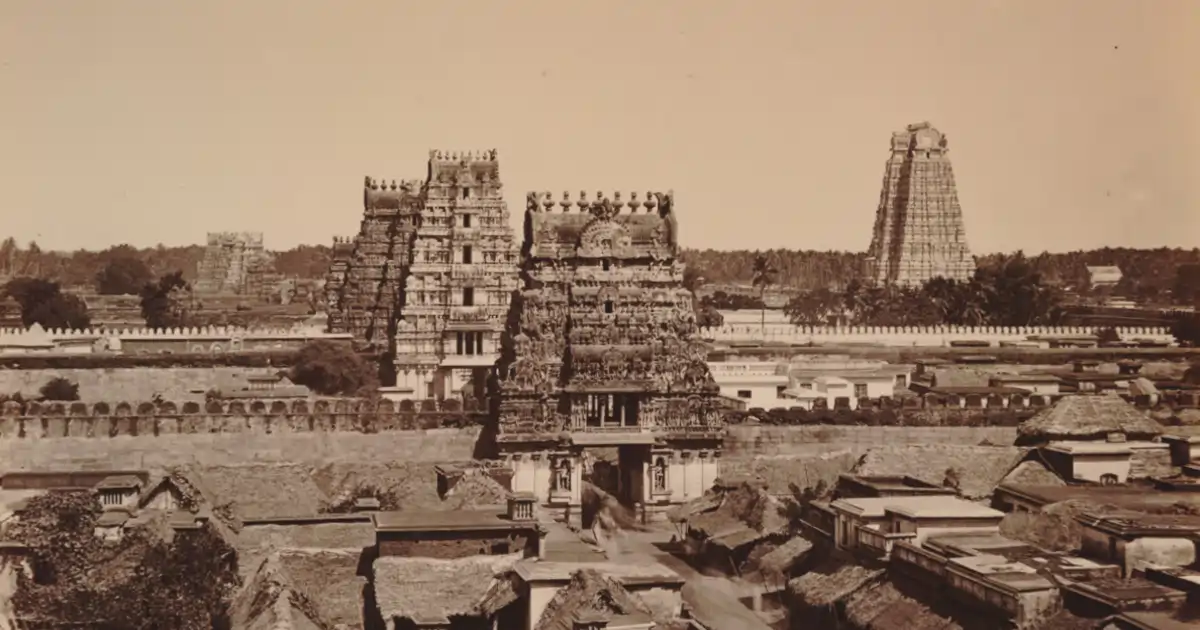
Temple of Sri Ranganathswami at Srirangam
Source: Shri Sudarshan Sandesh, Feb07-Apr07, pages 26-28 (as Published)
Estimated reading time: 10 minute(s)
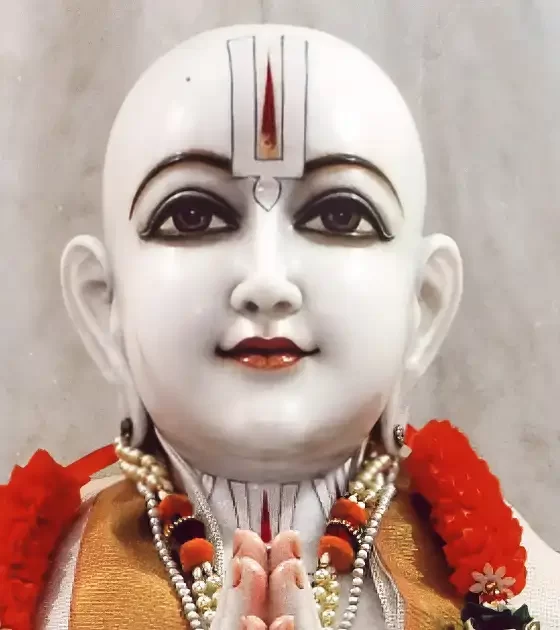
Walking down the corridors of the Sriranganathaswami temple at Srirangam, one would discover apocryphal stories unraveling at every point. The Lord, endowed with human traits and considered by the people as their own child “Ranga,” resides here. This ancient island town on the banks of the Cauvery throbs with life perennially and is home to many peace-loving residents who seem to be members of one huge family.
“The people of this town treat Ranganatha like their own child,” said my host L. P. Sampath as we sat on the ancient thinnai of his house near the entrance of the Srirangam temple. Before us, a seemingly endless stream of freshly bathed men, women, and children walked briskly past. Some held flowers in their hands, others carried baskets. But most of them were empty-handed. They were just going over to say good morning to their beloved Ranga before they began their day.
The temple of Sriranganathaswami at Srirangam is an ancient one. But then, almost everything in Srirangam is ancient with a continuing, traceable history to establish antiquity. Even the house in which we sat once belonged to a zamindar who housed his two ranis in it. A descendant of his, who was a famous musician, invited music luminaries like Veena Dhanam and Madurai Mani Iyer to perform in the very hall in which we now sat. Down the road was a matam established by the great Vaishnava philosopher Sri Ramanuja in the 12th century. The jeer of that matam still lived there. Beside it were houses that once belonged to Parasara Bhatta and Vyasa Bhatta, descendants of Koorahtalwar, a contemporary of Ramanuja. And their descendants still lived in them.
No one really knows when the Srirangam temple came into being. The actual shrine is supposed to have risen out of the Paarkadal (Ocean) itself as a result of Brahma’s penance. According to legend, Ikshvaku, a descendant of Surya, the Sun God, was appointed to take care of this divine gift. The shrine’s history, filled with myth and tradition, continues to be a living testament to the rich cultural and religious fabric of Srirangam.
The temple itself has seen contributions and renovations over the centuries. The 11th-century construction of one of the enclosures is attributed to Tirumangaialvar, who is believed to have lived there during the seventh century. Periyalvar, whose adopted daughter Andal was an ardent devotee of Ranganathaswamy, has also described the temple in his verses. Outside the main temple, there is a small shrine built on the spot where Andal is said to have become one with the Lord.
The most famous resident of the area, whose life and work have been well-chronicled, is Ramanujacharya. He was born in Sri Perumbudur around the year 1017 and spent the early part of his life in Kanchipuram. He came to Srirangam as a young sanyasi and was responsible for completely revamping the administration of the temple. Religious persecution compelled him to flee from Srirangam at the age of 80. With his band of devoted followers, he wandered all over the South before settling finally in Melkote in Karnataka.
Jatavarman Sundara Pandya I, a Chola king who reigned during the 13th century, was responsible for enlarging the temple and for covering the Lord with sumptuous gold and jewelry. According to temple chronicles, he once had two boats built on the Kaveri. In one boat he sat on the back of an elephant and in the other, he poured jewels and gold until it sank to the same waterline as the first. He donated all this treasure to the temple. This king, known as Hemachandra Raja or the king who covered the temple with gold, is said to have built and covered many of the main sanctuaries in gold and even built a jeweled arch to cover the Lord.
Malik Kafur, who caused the collapse of the Pandya dynasty in the 14th century, raided Srirangam and carried away most of its treasures. Ten years later, Mohammed Bin Tughlaq turned the temple of Srirangam into a fort. The priests of the temple took the Uthsavamurthy of Ranganathaswamy and whatever vessels and jewels they could save and fled. The idol of Thayar was buried in the temple courtyard itself.
For over 50 years, the Uthsavamurthy lived in exile. The temple functionaries managed to keep the Moolavars (main idols) safe by building a wall over them. The Uthsavamurthy is said to have traveled all over India and was finally kept at Tirupati, apparently hidden in a ravine. When peace returned, since the old idol could not be found, a new one was installed. The wall protecting the Moolavar was removed.
However, a couple of years later, the old idol suddenly resurfaced and there was a controversy as to which was the original one. A blind washerman, it is said, identified the true idol by the fragrance of kasturi which lingered on its vestments.
In Srirangam, myths, legends, and history are inextricably blended into apocryphal stories which the residents tell you as you walk down the corridors of the enormous temple. At one spot, for instance, there are five strange holes drilled into the solid stone floor in front of a pair of elegantly carved feet. Once, the story goes, Ranganatha decided to dress himself as Thayar and appear before his devotees because he wanted to understand why people only appealed to him through his wife. As he came down the corridor, dressed like a woman, Thayar is said to have stood in that corner of the passage hidden by the wall. As he neared, she inserted her fingers into those holes for grip and bent to peer around the wall to watch him coming.
The Lord of Srirangam has been endowed with some very human traits, which make it easier for the devotees to identify with him. During the Panguni Uthiram festival, for example, a unique quarrel is enacted every year between him and Sri Nachiyar (Thayar) at the Woraiyur temple close by. According to legend, for weeks before this day, which had been fixed for their marriage, Sriranga was nowhere to be seen. Sri Nachiyar heard stories of his wandering around, meeting other women, and so, when he finally appeared on their wedding day, she became very angry and threw out all the fruit, butter, and eatables prepared for the feast. He, however, finally pacified her and convinced her that he had only gone hunting and that the scratches on his back were made by a wild animal.
Unlike some other temple towns, Srirangam is throbbing with life right through the year. Trichy, being within easy commuting distance, makes Srirangam a desirable place to live. Families like those of Rangarajan, the veena maestro, attached to the temple, have been able to keep alive the family tradition without compromising on their education or outside careers, even while living in Srirangam.
Rangarajan’s family has been playing for the Lord for 43 generations. Every morning Ranganathaswamy is woken up by a male member of the family playing the veena. During Uthsavams, several of them walk in front of the deities with their veenas strapped across their bodies almost like guitars, playing and singing. Rangarajan himself retired as the principal of a college in Trichy. His four sons were educated there and all of them live and work in close-by places.
Narasimhan, a direct descendant of Vyasa Bhatta, is a school teacher. In his ancient house stands a shrine that almost looks like a miniature temple. Here he keeps some idols which he says have come down to him from his famous ancestor. His 13-year-old son Senthamaraikannan has already gained mastery over complicated Sanskrit slokas. Narasimhan, who visits the temple several times a day, is confident that his only son will keep the family tradition alive.
Surprisingly, for a religious center that has no other industry, Srirangam has not stagnated. Some years ago, the late Jeeyar of the Ahobila Matam decided to complete a gopuram that had been left unfinished by previous builders. He succeeded in collecting the enormous resources and manpower required for this project and constructed the gleaming new gopuram at the entrance of the temple before he passed away.
Over the past few years, some apartment complexes have also come up on the banks of the Cauvery which flows on either side of this small island town. Retired government servants, senior citizens whose children have settled abroad, and others wishing to settle in this peaceful, religion-oriented community live here. R. Rajagopalan, who retired from the P & T department last year, finds life at Srirangam very peaceful and surprisingly busy. Although he had a house in Madras and has lived all over the country, he preferred to settle here with his wife Indra, who is a veena teacher. Both of them visit the temple several times a day.
L. P. Sampath, who once worked for a multinational bank and also has a house in Madras, finds himself inexplicably attracted to Ranganathaswamy. “I came here four years ago,” he says. “I have no roots in this area. Yet I cannot leave. He is holding me here.” The temple, which forms the social as well as the religious hub of the township, is full at any time of the day or night. “We all keep meeting each other in the temple,” Sampath says as we walk down a dirt road and he waves out to some young men wearing traditional top knots and playing cricket. “Everyone knows everyone else here. It is like one huge family. You cannot get this feeling in Madras.”
But Srirangam is no idyllic community uncontaminated by the outside world. As we sat in a friend’s house watching cable TV and a totally urban-oriented discussion on the ostentatious display of jewelry and lavish weddings, the tensions surfaced briefly. “All these exist in Srirangam too,” said a young bride-to-be. For the young, the “one huge family” atmosphere can be uncomfortable. Apart from the fact that they have no privacy and no outlet for their youthful interests, they have to keep within some traditional bounds which they find archaic and inconvenient.
And so, as in other such communities, the young migrate, leaving the older ones to hold onto the roots and keep them nurtured. But, as a resident put it, ultimately many of them return, having experienced the outside world and got fed up with it. For the attraction of Ranga is quite formidable.
Summary:
The Sriranganathaswami temple in Srirangam is a central part of the ancient island town on the banks of the Cauvery River. The town’s residents treat the deity, Ranganatha, like their own child, and the temple is a focal point of both religious and social life. The history of the temple is filled with myths, legends, and historical events, such as the contributions of various saints and kings, including Ramanujacharya and Jatavarman Sundara Pandya I. Despite historical challenges like invasions and plundering, the temple has remained a symbol of the community’s devotion and resilience.
Srirangam’s culture is deeply intertwined with its religious traditions, and the temple influences the daily lives of its residents. Notable families, like that of the veena maestro Rangarajan, have maintained their religious duties for generations while balancing modern education and careers. Despite being a religious center, Srirangam has adapted to contemporary life, with new apartment complexes and a community that includes retired professionals and senior citizens. However, the traditional lifestyle and the close-knit community atmosphere sometimes clash with modern desires for privacy and individual freedom, leading younger generations to migrate, though many eventually return.
Important Points:
Cultural and Religious Hub:
- The Sriranganathaswami temple is central to the town’s life, with residents treating the deity Ranganatha as their own child.
- The temple has a rich history filled with myths, legends, and historical contributions from various saints and kings.
Historical Significance:
- Contributions by Ramanujacharya in the 12th century and Jatavarman Sundara Pandya I in the 13th century.
- Survived invasions and plundering, notably by Malik Kafur and Mohammed Bin Tughlaq.
Generational Traditions:
- Families like Rangarajan’s have maintained religious duties for generations.
- Balancing traditional roles with modern education and careers.
Modern Adaptations:
- New apartment complexes and a community of retired professionals and senior citizens.
- Continuous life and activities throughout the year.
Community and Social Life:
- Close-knit community with a feeling of one large family.
- Social interactions often centered around the temple.
Challenges of Modernity:
- Traditional lifestyle and close community atmosphere can be restrictive for the younger generation.
- Many young people migrate but often return after experiencing the outside world.
Enduring Attraction:
- The temple and its deity hold a strong, enduring attraction for residents, keeping the community connected to its roots.