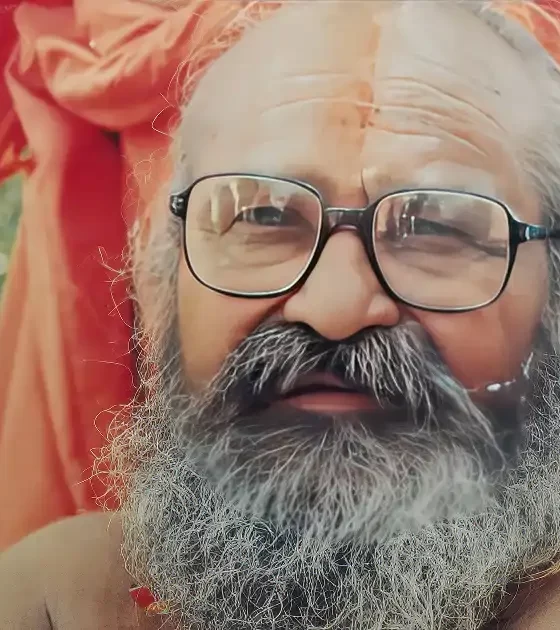
Our Great Saint: The Birth of Sri Ramanuja
Source: Shri Sudarshan Sandesh, May07-Jul07, page 32-35 (as Published)

Estimated reading time: 11 minute(s)
by Rameshwar Singh
There is a prosperous village called Sriperumbudur, thirty miles southwest of Madras. In the village, there is a beautiful and spacious temple consecrated to Lord Vishnu. Within the sanctum sanctorum stands Lord Sri Adikesava Perumal, with a smiling face casting gracious looks equally on all. On the other side of the temple courtyard stands another shrine, within which is seated, with folded hands, in the place of the chief servant, the prince among ascetics (Yatiraja), Sri Ramanujacharya, the Commentator. A hero among devotees and a lover of them too, he is to Vedanta what the sun is to the lotus. In the front, a spacious tank of limpid water, rippleless like the pure heart of a devotee, reflects the entire temple within it. Besides, the natural beauty of the place is attractive. Shaded by various kinds of trees and creepers, sonorous with the sweet twittering of birds, lit up and fragrant with blossoming flowers, and inhabited by happy, good, healthy people, the place abounds in peace, sweetness, and beauty. The sight of it strikes one as if the Consort of Lakshmi, incessantly engaged in preserving the universe, sometimes gets tired and comes over here to rest with His most beloved servant.
More than a thousand years ago, a pious Brahmana named Asuri Kesavacharya lived in this village. Sri Yamunacharya (Alavandar), after renouncing his throne and accepting the discipleship of Nambi, was living as a mendicant at Srirangam. After the passing away of his Guru, Alavandar was accepted as the leader of the entire Vaishnava community of the time. His uncommon renunciation, dispassion, erudition, humility, and steadfastness toward his Chosen Ideal were admired by all the Vaishnavas. All pious men considered themselves blessed in eagerly learning and memorizing the sweet hymns composed by him. Truly speaking, in his hymns, Mahatma Yamunacharya has dedicated himself to the lotus feet of God in such a candid manner and with such tremendous devotion and love that, upon reading them, devotion springs up in the heart of even a heretic. Devoted Vaishnavas coming from all quarters deemed themselves extremely fortunate to be his disciples. Among them were one or two who, like him, adopted the life of Sannyasa. By living in his company and being engaged in his service, they gained a sense of perfect fulfillment in their lives.
Periyatirumalai Nambi (also called Sri Sailapurna), of advanced age, was Yamunacharya’s chief disciple. Towards the end of his life, he renounced the life of a householder and, receiving Sannyasa from his Guru, continued to live with him. He had two sisters. The name of the elder one was Bhumi Piratti, Bhudevi, or Kantimati; the name of the other was Periya Piratti or Mahadevi (called Sridevi or Dyutimat).
Asuri Kesavacharya of Sriperumbudur married Kantimati. The younger Mahadevi was wedded to Kamalanayana Bhatta of the nearby village Aharam. After the marriage of the two sisters, Sri Sailapurna devoted himself entirely to the meditation of God with a free mind. At last, finding a great Guru like Mahatma Yamunacharya, he came to enjoy supreme bliss by living in his company.
Asuri Kesavacharya was very much attached to the performance of Yajnas, and so the Pundits gave him the title ‘Sarvakratu,’ which literally means the performer of all Yajnas. His full name was Srimad Asuri Sarvakratu Kesava Dikshita. After their marriage, the couple lived happily for many years at Sriperumbudur. But as no child was born to them, Kesavacharya began to feel concerned. At last, the hope of getting a son by the grace of God through the performance of Yajnas arose in his mind, for there is a scriptural statement: “A son can be obtained by performing Yajnas.”
He decided to go to Sri Parthasarathi, the dweller of Vrindaranya on the shores of the sea, to supplicate the Lord and perform sacrifices for that end. Accordingly, he, accompanied by his wife, appeared in Vrindaranya on the banks of Tirualikeni or the lily-lake of Parthasarathi in modern Madras. They performed Yajnas with the desire that a son might be born to them. The name of that locality of Madras is Triplicane, which is the English corruption of Tirualikeni. What was previously known as Vrindaranya has now come to be known as Triplicane after the name of that lake.
After the performance of Yajnas, Kesavacharya had a vision of Parthasarathi in a dream. In his dream-state, he heard the Lord address him and say, “O Sarvakratu, I am much pleased with your good conduct and steadfast devotion. Be not anxious. I Myself shall be born as your son. Instigated by evil motives and unable to understand the teachings of preceptors, men are considering themselves to be the Godhead and, out of pride, are becoming wicked, willful, and perverse. Unless I incarnate Myself as an Acharya, they are doomed. Go back home with your wife. Your desire will be fulfilled.” Having dreamt such an auspicious dream, Kesavacharya’s joy knew no bounds. He told his wife everything, and the following day they returned to their village.
About a year later, the fortunate Kantimati gave birth to a son endowed with all auspicious marks, who came to be known as Sri Ramanuja. He was born in 939 of the Saka era (4118 of the Kali era and 1017 of the Christian era) on Thursday, the 12th Chaitra, on the fifth day of the bright fortnight, when the sun was in the zodiac of Cancer in the year Pingala. His natal star was Ardra, the sixth lunar mansion. He belonged to the Harita lineage and Yajur Veda. Being so born, he appeared before all like the newly risen sun dispelling the darkness of ignorance. His birth caused the destruction of evil-mindedness and brought about an efflorescence of right understanding in men. Scholars ascertain his year of birth with the help of the word ‘dhirlabdha’ (which literally means ‘knowledge has been attained’).
About the same time, the younger sister Mahadevi also gave birth to a son. A few days after the confinement, she came to Sriperumbudur with her newborn babe to see the son of her elder sister Kantimati. Each was extremely glad to see the face of the other’s child. In the meantime, the old Sri Sailapurna, who heard the news, also came from Srirangakshetra with the intention of seeing the two newborn nephews. Both Kantimati and Mahadevi were immensely delighted to receive their brother after such a long time. The old Sanyasin was also very glad to see the two little infants endowed with all the auspicious signs. When he saw Kantimati’s son marked with various divine traits, he was reminded of what Nammalvar had foretold as the future messiah of Sri-vaishnavism in his Tiruvoymozhi. He no longer had any doubt that this babe was the incarnation of Lakshmana, the Anantadeva of Kali Yuga, about whose advent references can be found in the thirty-second chapter of the Brihat Padmapurana, Naradapurana, and the twenty-third chapter of the Skandapurana. It is also stated in the fifth chapter of the eleventh Skandha of Srimad Bhagavatam that great devotees of Narayana will be born in the Dravida country in the regions through which rivers like Palar, Cauvery, Tamraparni, and Periyar flow. Accordingly, he named the child Sri Ramanuja.
Mahadevi’s son was named Govinda. Later, Mahadevi became the mother of a second son, who came to be known as Junior Govinda.
The great sage Valmiki, the ancient poet, writes:
“In the month of Chaitra under the ninth lunar mansion, when the sun had gone to the sign Cancer of the zodiac, Lakshmana and Satrughna were born.”
The month of birth and zodiac of Sri Ramanujacharya are the same as those of the sons of Sumitra.
When the two babes were four months old, the mothers came out of confinement and, taking the babes in their laps, made them see the sun. Afterwards, the ceremonies of rice-taking, the piercing of the earlobes, the first tonsure, initiation in studies, and investiture with the sacred thread were performed in due course. From his very childhood, Ramanuja showed prodigious intellectual abilities. By hearing a lesson only once from his teacher, he could grasp its meaning and never forget it. For this reason, he was beloved by all teachers.
Ramanuja’s intellectual powers were not only directed outward, like a compass needle showing north and south, representing Dharma and Artha, the first and second of the four ends of life. The cultivation of righteousness and association with holy men were also very dear to his heart. He missed no opportunity to associate with holy men.
At that time, a great devotee named Sri Kanchipurna, widely known for his devotion, lived in the city of Kanchi. He used to go every day from Kanchi to Poonamalle, a neighboring village, to worship the deity there. Sriperumbudur is midway between these two places. So he would pass by Ramanuja’s house every day. Though a Sudra by caste, even Brahmanas revered him for his deep devotion to God. One evening, Ramanuja, on his way back home from his preceptor’s house, met this holy man and, seeing the divine luster on his face, felt naturally drawn to him. With great modesty, he requested him to take his meal at his house that night. Seeing the celestial beauty and divine marks in the boy, Kanchipurna could not refuse the invitation. Finding this holy man as his guest, Ramanuja could not contain his joy. After the guest had eaten, Ramanuja went forward to stroke his guest’s feet with his hands as a gesture of devoted service. But the guest would not permit it. He said, “I am a low-born Sudra. How could you serve your servant?” Saddened by this, Ramanuja said, “I would consider it my bad luck if I could not serve a noble soul like you. Pray, noble Sir, is it the wearing of the sacred thread that makes one a Brahmana? He who is devoted to God is a genuine Brahmana. You know very well how Tiruppanalvar, low-born though he was, came to be worthy of the worship of Brahmanas.”
Struck by the devotion of the boy, Sri Kanchipurna could not consider him to be a mere human being. After long spiritual conversations, he rested for the night at Ramanuja’s place and proceeded towards his destination in the morning. From that day, both were bound together by the love each bore for the other.
The previous Acharyas cited the authority of the Puranas to regard Ramanuja as the incarnation of Lakshmana. When we compare the character of the son of Kesava (Ramanuja) with that of the son of Sumitra (Lakshmana), we find many similarities. Lakshmana was peerless in dutifulness, steadfastness to truth, devotion to Rama, mastery over the senses, and righteousness. Sri Ramachandra was the sovereign of his heart. He knew no other bliss than that of serving Rama. It is no wonder that he stayed far away from the enticements of the world. We realize this when we bathe in the Ganga of the Ramayana, which springs from Valmiki the mountain and flows into Rama the ocean.
When the golden deer, after deluding the daughter of Janaka, had also deluded Sri Ramachandra, Lakshmana cautioned the Chosen Ideal of his heart in the following manner:
The be-all and end-all of Lakshmana’s life was only the service of Rama and Sita. After the killing of Ravana, his departed father Dasaratha, appearing with the gods, blessed and admired him, saying:
“My boy, by serving Rama and Sita, the Daughter of Videha, unreservedly, you have earned both virtue and great fame.”
The summum bonum of Sri Ramanuja’s life was the service of Lord Narayana. When the base-natured leaders of society robbed human hearts of devotion to God, like Ravana kidnapped Sita, Sri Ramanuja, like the true younger brother of Sri Rama, fought to the end with the heretics to recover the Sita of devotion and was ultimately successful in his mission. By installing Sri on the flank of Narayana, he brought back the goddess of fortune to the unfortunate land of India. Excerpts from: The Life of Ramanuja
Summary:
The article recounts the story of Sriperumbudur, the birthplace of Sri Ramanujacharya, a revered philosopher and theologian in the Vaishnavism tradition. It describes the village’s prosperity and the beauty of its temple dedicated to Lord Vishnu. It narrates the lives of Ramanuja’s parents, Asuri Kesavacharya and Kantimati, who performed yajnas (sacrificial rituals) to be blessed with a child. Their devotion was rewarded when Lord Parthasarathi appeared in Kesavacharya’s dream, promising to be born as their son. Ramanuja was born in 1017 CE, and his birth brought joy and a sense of purpose to the village. The article highlights Ramanuja’s early life, his intellectual abilities, and his association with holy men like Sri Kanchipurna. It emphasizes Ramanuja’s devotion to Lord Narayana and his mission to restore and spread devotion in the face of heretical beliefs, drawing parallels between his life and the character of Lakshmana from the Ramayana.
Important Points:
- Sriperumbudur: Prosperous village with a temple dedicated to Lord Vishnu, birthplace of Sri Ramanujacharya.
- Sri Ramanujacharya: Born in 1017 CE to Asuri Kesavacharya and Kantimati after performing yajnas.
- Divine Promise: Lord Parthasarathi appeared in Kesavacharya’s dream, promising to be born as his son.
- Early Life: Ramanuja showed prodigious intellectual abilities and was beloved by his teachers.
- Holy Associations: Ramanuja formed a significant relationship with the holy man Sri Kanchipurna.
- Devotion to Narayana: Ramanuja dedicated his life to serving Lord Narayana and restoring devotion.
- Parallels to Lakshmana: Comparisons drawn between Ramanuja and Lakshmana, emphasizing duty, devotion, and righteousness.
- Restoration of Devotion: Ramanuja’s efforts to combat heretical beliefs and bring back the goddess of fortune to India.